
Are They Tyrants?
An Examination of Hollywood’s Executive Class

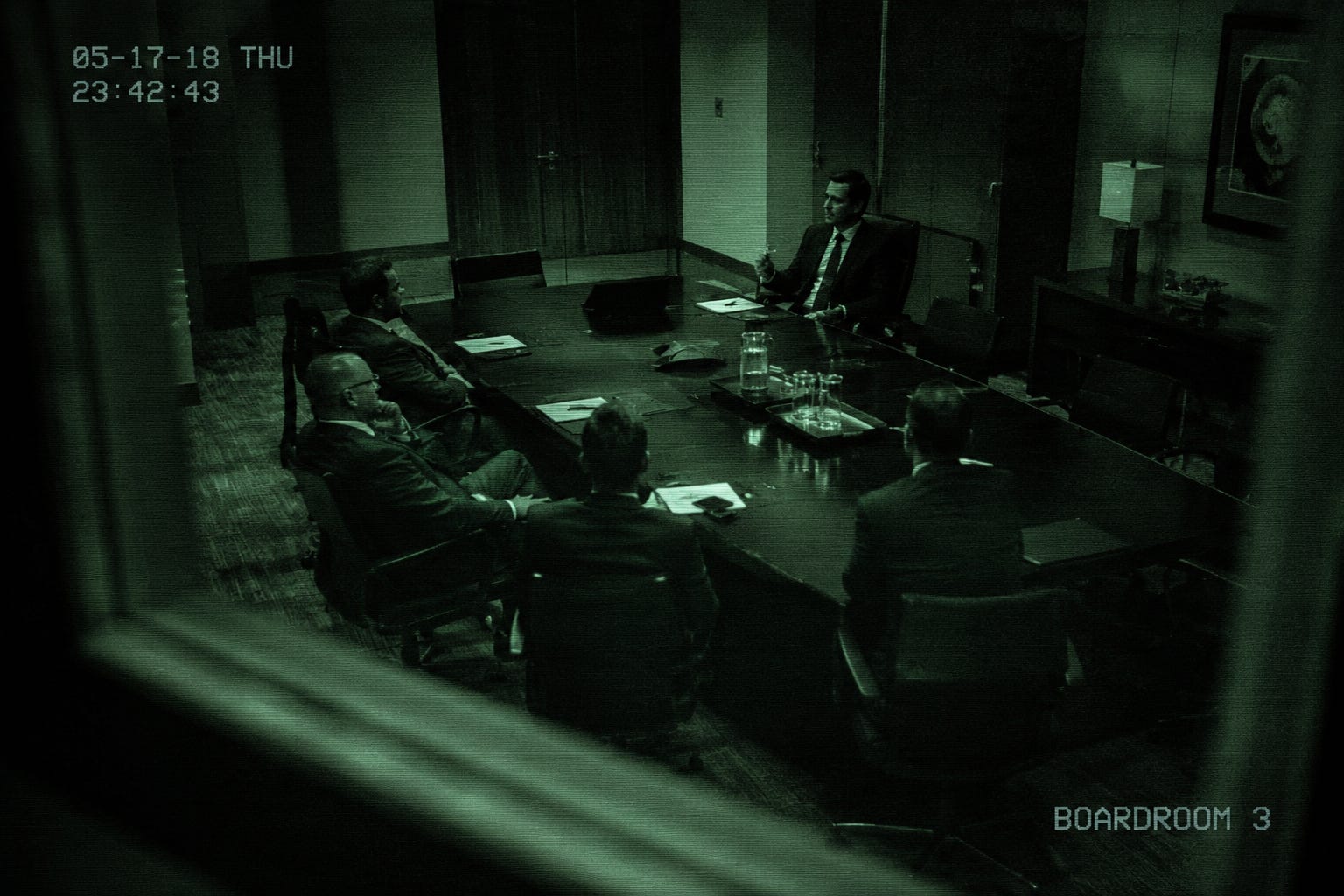
Maybe I’m trying to find my center again by writing this.
That’s probably the honest place to start.
Because I’m not standing outside the blast radius here. I was part of this machine. A middle sized part, but definitely front row. I sat in those rooms. I learned the language. I learned how to talk about risk while rarely taking one. I learned how to make fear sound professional. I learned how to say “the market” when what I really meant was, “Real, actual people won’t like this and I can’t defend it.”
So no, this is not a sermon from some clean moral hilltop.
It’s an autopsy.
And I’m on the table too.
I’ve learned that institutions do not collapse when corruption enters.
It’s all about reality.
They collapse when reality can no longer reach the center.
That is the wound.
Not greed.
Not bad taste.
Not cowardice, though there’s plenty of that lying around.
Those are symptoms.
The disease is the loss of reality.
At some point, a company stops seeing itself clearly. The reports get softened. The forecasts get massaged. The bad news gets delayed, reframed, buried, or turned into a prettier deck.
No one has to say, “Lie to me.”
They don’t need to.
The organism learns.
People figure out what power wants to hear.
Then they bring that.
Again and again and again and again.
Until the center is no longer governing the actual company, the actual audience, the actual market, the actual culture, or the actual work.
It’s governing a simulation.
That is where Hollywood is now.
Not because every executive is a tyrant.
Because the system has taught too many of us that telling the truth is professionally dangerous.
The Distortion Field
The modern entertainment company is wrapped in a distortion field.
Every meeting edits reality just a little.
Every deck edits it just a little more.
Every internal read, every strategy memo, every “we love this but...,” every piece of corporate language designed to make fear sound like this thoughtful idea.
I know this because I’ve done it.
I have been in the room where bad news became “a positioning challenge.”
Where a dead project became “not quite there yet.”
Where audience disinterest became “a discoverability problem.”
Where nobody wanted to admit the thing didn’t work because too many people had already blessed it.
By the time reality reaches the center, it has been washed, folded, and made safe for people who do not want to be surprised.
The movie did not fail.
It “underperformed.”
Nobody knows what works.
So we “lean into proven IP.”
Artists are losing trust.
So we launch a “creator-first initiative.”
The language gets smoother as the room gets sicker, and that’s how institutions protect themselves from the truth.
The Autoimmune Disease
Healthy institutions have immune systems.
People who can say no.
People who can contradict power.
People who can bring ugly facts into the room before the ugly facts become fatal and cost them their jobs.
A healthy studio needs people who can say:
This movie is dead.
This audience does not exist.
This star doesn’t bring what you think they bring.
This franchise is out of blood.
This budget is insane.
That is institutional health.
But sick institutions reverse the immune system.
They start attacking reality instead of protecting the body.
Honesty becomes disloyalty.
Bad news becomes negativity.
Taste becomes “subjective.”
Experience becomes “resistance to change.”
The person telling the truth becomes the problem.
Not the broken system.
Not the bad strategy.
The truth-teller.
That is the autoimmune disease of Hollywood.
The body mistakes reality for threat.
What I Learned In The Machine
Most executives did not create the distortion field, but rather, they inherited it
Then they learned to survive inside it.
It’s how the machine works.
The younger executive learns quickly which truths move upward and which truths end careers. You learn what kind of passion is useful. You learn how to praise risk while quietly pushing everything toward the safest possible version of itself.
You learn the court language.
Elevated, premium, four-quadrant, auteur-driven.
No one knows what half of this bullshit means anymore.
That is the point.
The language lets everyone sound serious while avoiding the simpler question:
Is this even alive?
I learned that language and I used it.
And I don’t think I fully understood how much it was changing me while I was using it.
That’s the thing about institutions. They don’t just tell you what to do. They teach you what to notice. What to ignore. What to soften. What to call “strategy” when your gut knows it is fear.
Are They Tyrants?
Some are.
Let’s not be precious.
Some people enjoy power. Some enjoy saying no. Some enjoy making artists wait, bend, explain, shrink, flatter, and beg. Some have mistaken proximity to taste for taste itself.
But most are not tyrants in the old sense.
They are functionaries inside a frightened institution.
Which may be worse.
A tyrant knows he is ruling.
A functionary can destroy something while believing he is protecting it.
A functionary can starve a culture while saying the market demanded it.
That is the more useful indictment.
Not that Hollywood is run by monsters.
That would let everyone off too easily.
The indictment is that Hollywood built a professional class trained to survive reality by editing it.
And I was trained too.
That is the part I have to sit with.
What This Does To Artists
This does not just create bad business.
It changes the artist.
Artists start pre-editing themselves before anyone asks.
They make the work smaller in the pitch, cleaner in the deck, and safer in the room.
They learn to anticipate the institutional allergy and remove the dangerous thing before the company has to reject it.
That is the real damage.
It’s not rejection; rejection is normal.
The deeper damage is when the artist begins carrying the institution’s fear inside their own creative process and calls it professionalism. Or even sadder, failure.
That is how the distortion field spreads.
First the company stops receiving reality.
Then the artist stops making from it.
And this is another place where I feel implicated
Because I have given those notes.
I have asked for the cleaner version.
I have wondered whether the room would buy the safer shape.
I have watched something alive get translated into something acceptable.
Sometimes I fought it.
Sometimes I didn’t.
That’s the truth from where I sat for those decades.
The First Casualty
The first casualty of power is accurate information.
That is true in politics, corporations, studios, etc.
It is true anywhere people learn that bad news is dangerous and obedience is rewarded.
Eventually, everyone edits reality before passing it upward.
Then the people at the center make decisions based on a world that no longer exists.
And the rest of us are expected to live with the consequences.
The Way Back
Hollywood does not need better slogans.
It does not need another creator-first panel moderated by someone who has never risked rent on a cut.
It does not need more brand language about boldness from companies addicted to safety.
It needs reality to reach the center again.
That means executives who can hear the truth without punishing the person who brought it.
It means companies with enough institutional confidence to say yes before consensus makes the answer obvious.
It means artists who stop sanding themselves down for rooms that may never be brave enough to deserve the work.
It means producers, filmmakers, writers, and creators building enough independence that a single frightened center is no longer the only place reality has to travel.
And maybe, for some of us, it means admitting what the machine taught us.
Admitting where we participated.
Admitting where we benefited.
Admitting where we protected the room instead of the work.
Because once an institution loses the ability to perceive reality, it becomes vulnerable to anyone who promises certainty.
That is where we are.
A town full of uncertainty.
A business desperate for certainty.
An executive class trained to confuse control with leadership.
And artists carrying the very reality the institution claims to want.
So are they tyrants?
Sometimes.
But the bigger problem is not tyranny.
The bigger problem is that Hollywood has become an institution where reality gets treated like a threat before it reaches the people with power.
And no institution survives that forever.
Maybe I’m writing this because I want Hollywood to find its center again.
Maybe I’m writing it because I’m trying to find mine.
Alex LeMay is a filmmaker, showrunner, journalist, and development executive. PitchCraft publishes dispatches from the intersection of storytelling, and the business of making things. Subscribe now and get updates in your inbox every week.
Thank you so much for sharing. I found this super interesting as an ex-film geek but also as a citizen watching the deteriorating state of affairs both near and far.